The Goa Stone: Made in India for European Elites, Displayed in the Islamic Galleries at The Met
During a research visit to the Metropolitan Museum of Art in New York, I encountered a striking object in the Islamic galleries that immediately raised questions about categorization and meaning. The object was a Goa stone housed in an elaborate gold container. At first glance, its presence in the Islamic art section seems unexpected. Goa stones were produced in western India under Jesuit supervision, circulated among European elites, and often feature imagery drawn from European visual traditions. Yet the object’s placement ultimately reveals the complexity of early modern artistic exchange rather than a curatorial error.
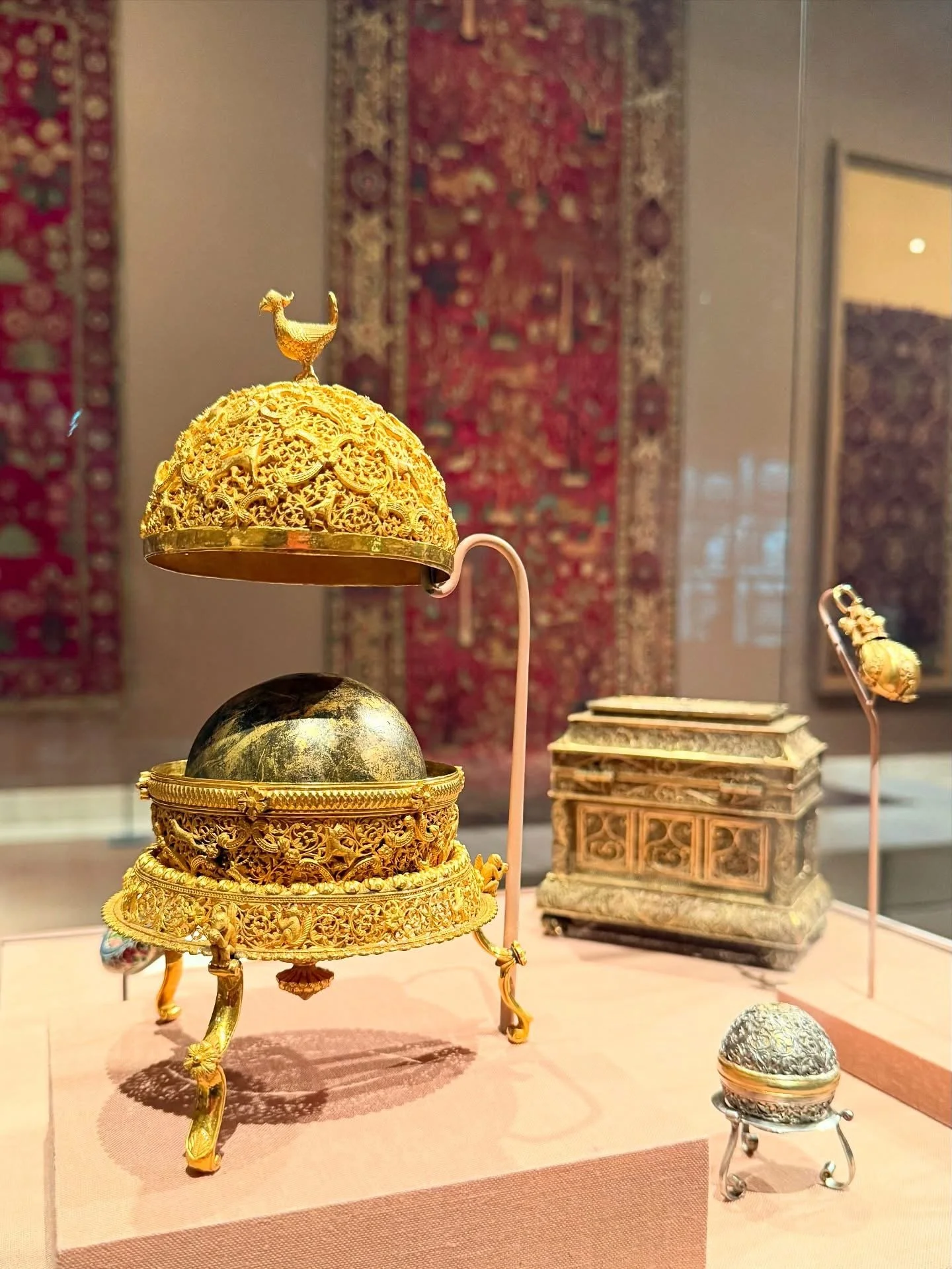
This object belongs to a category of portable talismans known as Goa stones, named after the port city of Goa where they were reputedly produced during the late seventeenth century. Although artificially fabricated, Goa stones were understood as substitutes for bezoars, calcified substances found in the stomachs of ruminant animals and long valued across Asia and Europe for their perceived medicinal and protective powers. Within early modern medical and devotional cultures, the authority of these stones depended not only on their ingredients but also on their careful preparation, presentation, and circulation among trusted networks.
The stones were typically formed from dense composite pastes that combined powdered bezoar with clay, silt, crushed shell, resin, amber, musk, and fragments of precious or semiprecious stones. In some cases, narwhal tusk, believed at the time to be unicorn horn, was added to enhance the object’s potency and rarity. Once shaped into a sphere, the surface was often gilded. Small shavings taken from the stone could be dissolved in water or tea and ingested as a remedy against poisoning or illness. This practice reflects a medical logic in which material proximity, ingestion, and belief were inseparable. Writings such as Garcia da Orta’s sixteenth century treatise produced in Goa attest to the deep interest in bezoars and their substitutes within Indo Portuguese medical thought.
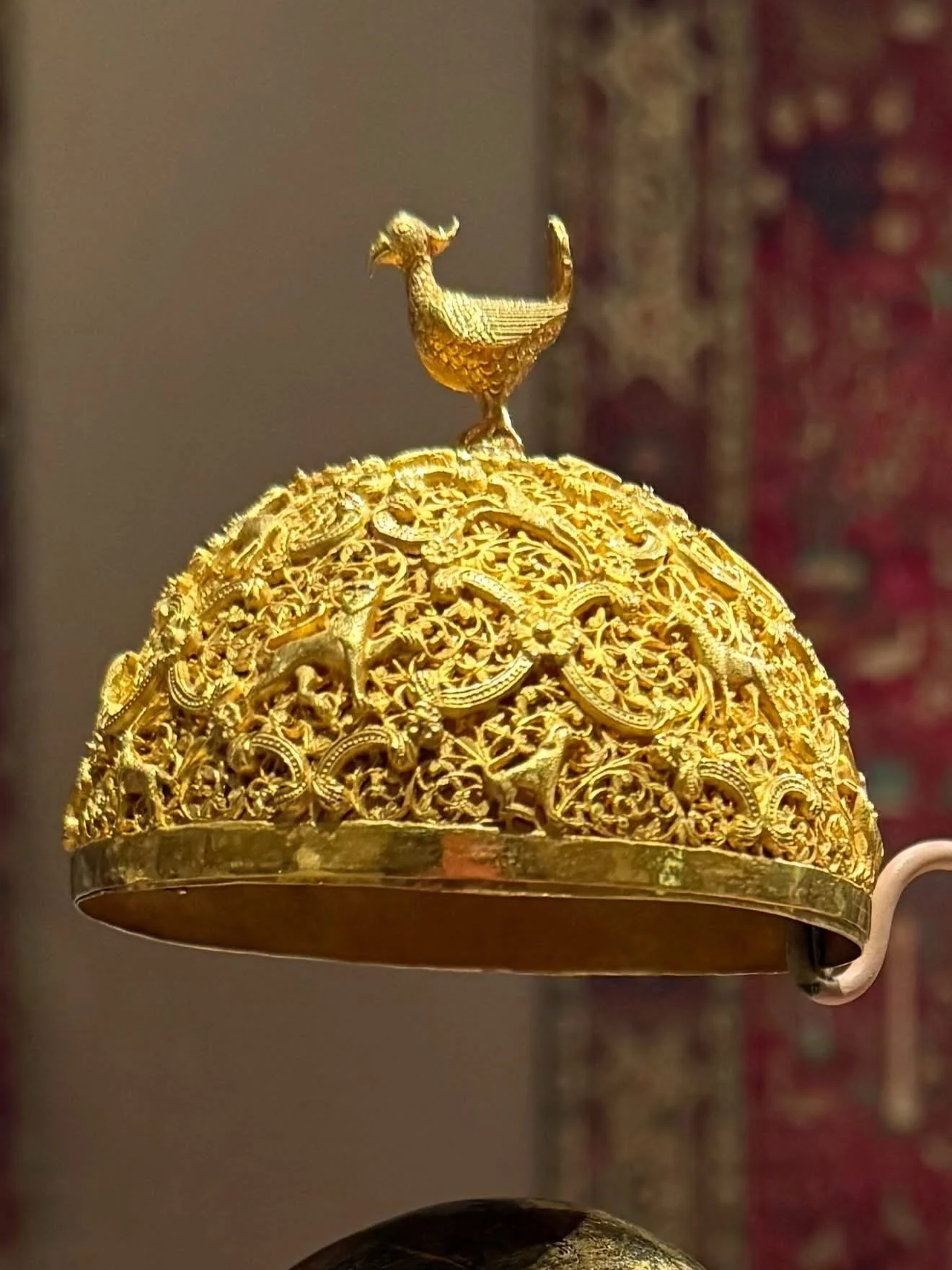
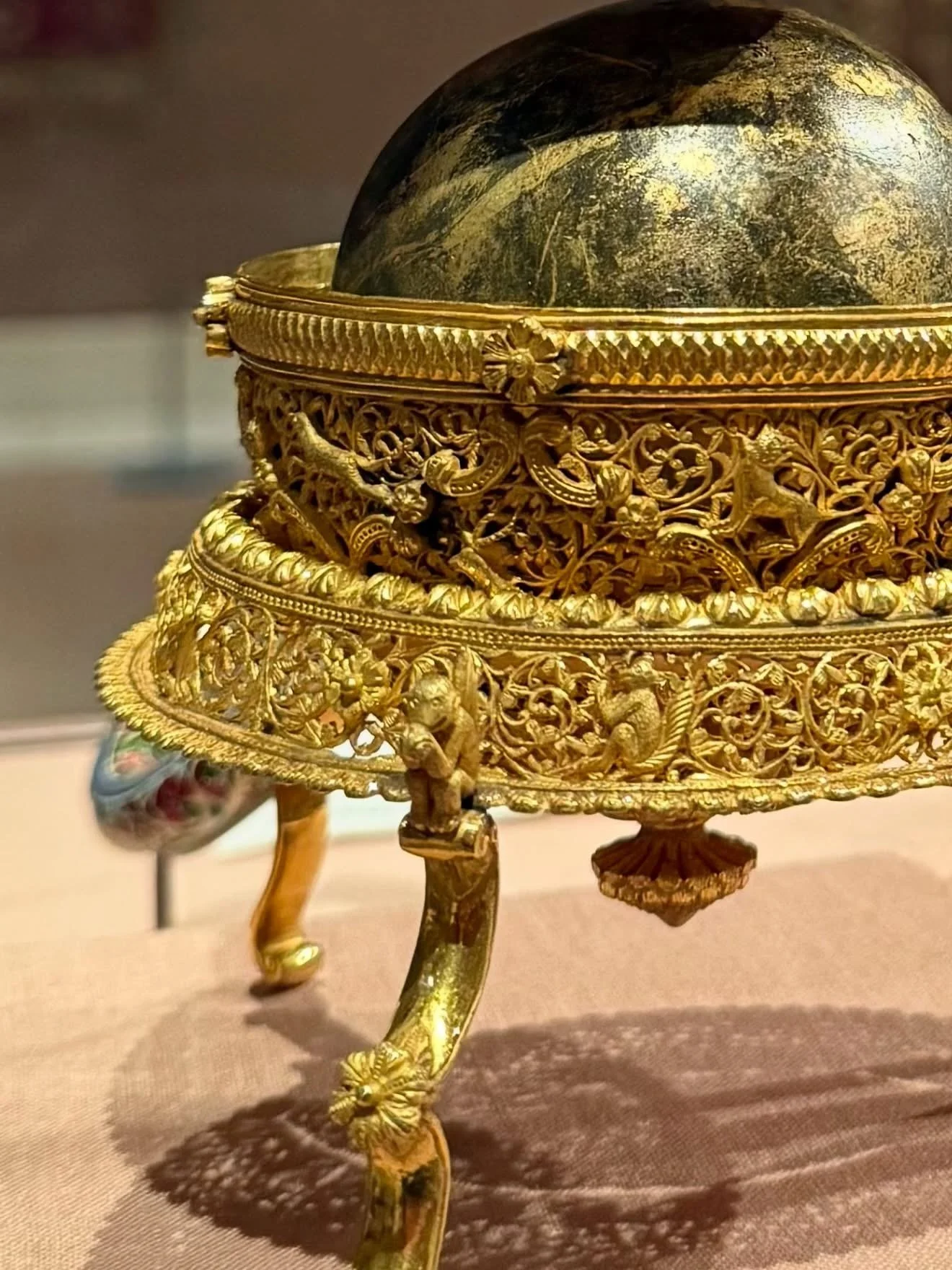
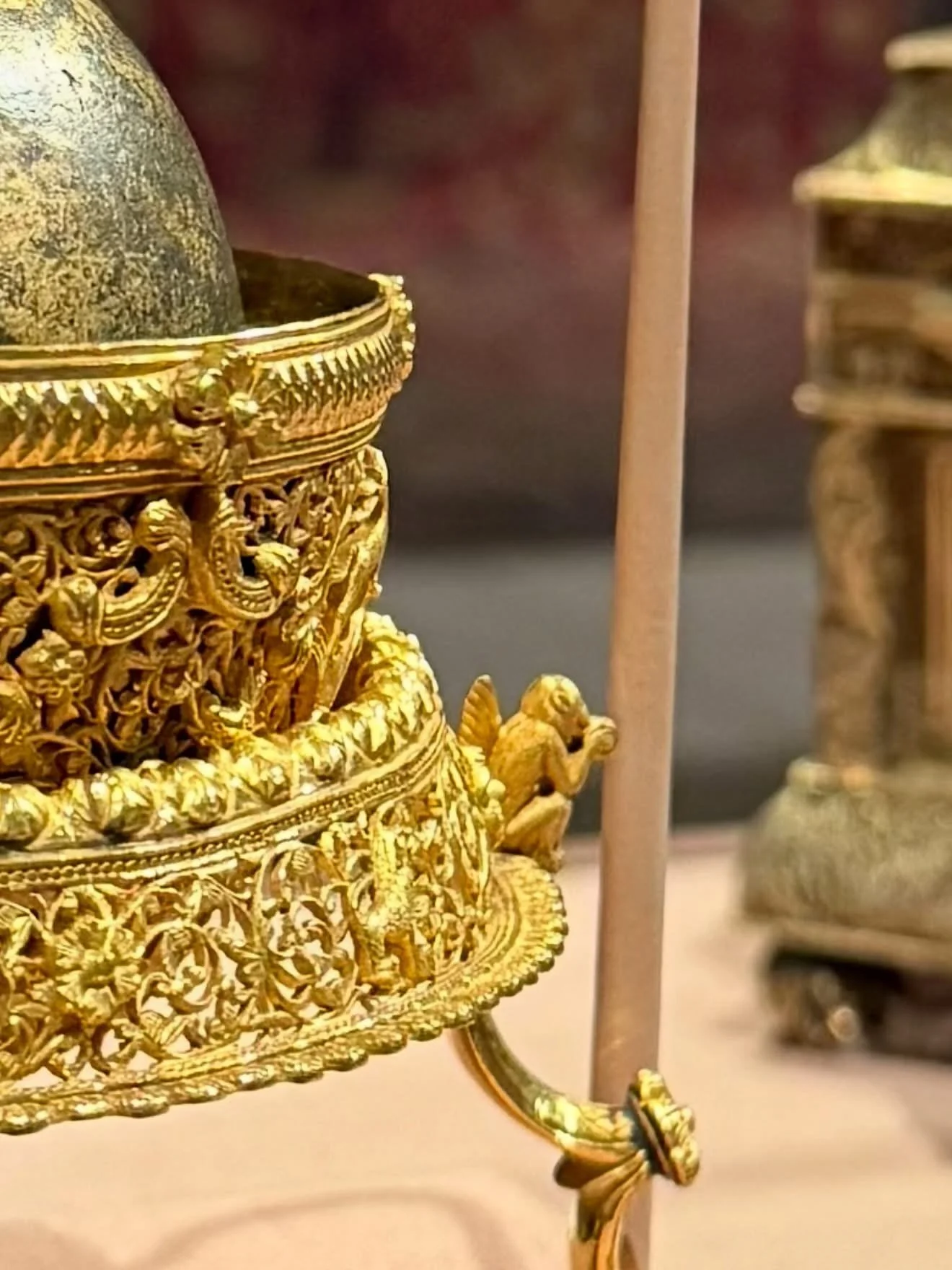
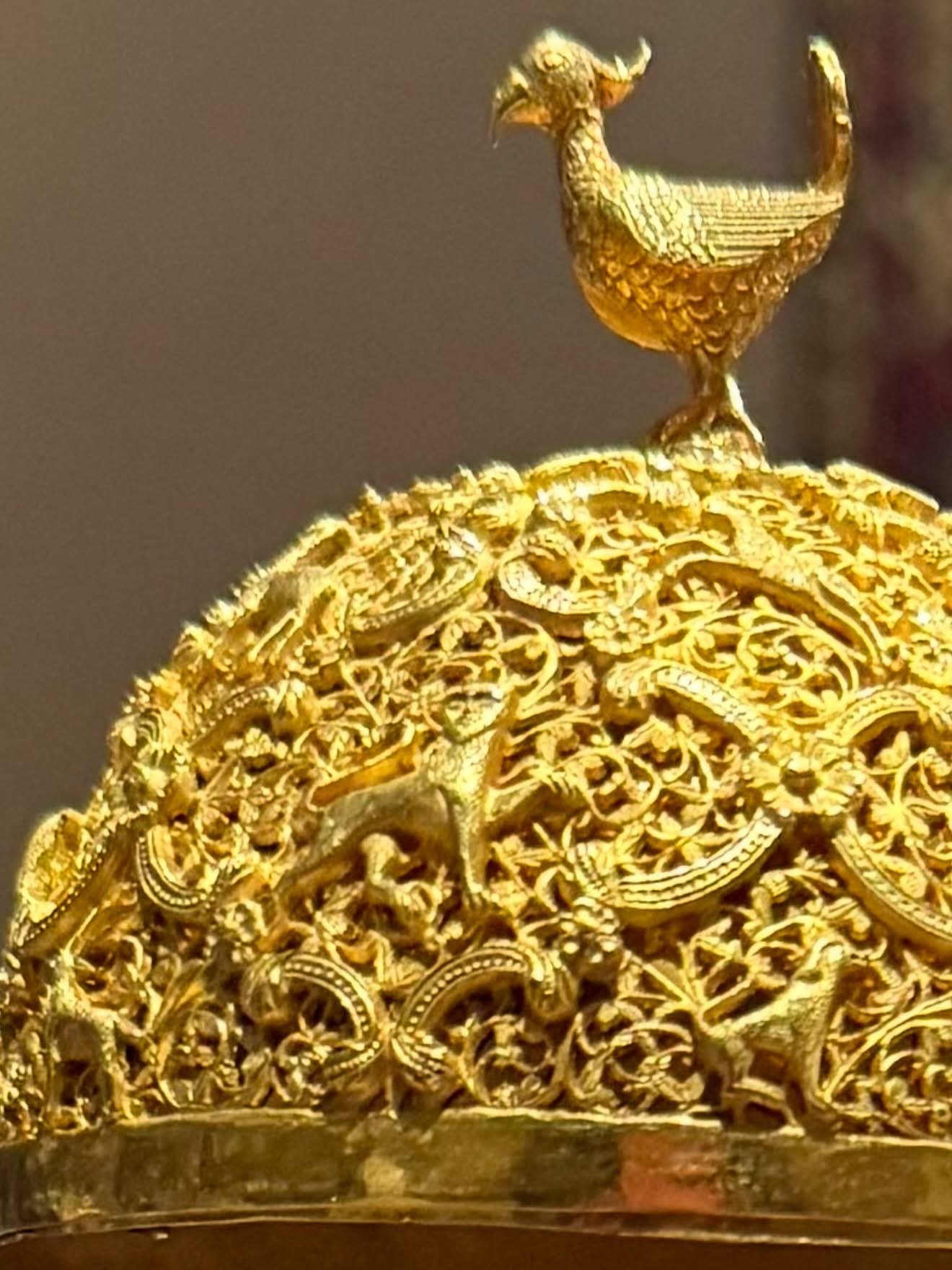
The container enclosing the stone is as significant as the stone itself. Far from functioning merely as a protective shell, the gold mount was believed to amplify the stone’s effectiveness. Contemporary accounts note that Goa stones were routinely set in gold for this reason, ensuring the constant presence of a precious and symbolically charged material. Such mounts also enabled the object’s movement into elite European collections, where Goa stones were prized within royal treasuries and cabinets of curiosity as marvels from distant territories. Their association with royal ownership, including examples attributed to Elizabeth I, underscores the status these objects carried.
The present container exemplifies the stylistic hybridity typical of Indo Portuguese luxury production. Its globular form is constructed from two joined gold hemispheres and covered with pierced and chased vegetal ornament. The decorative vocabulary draws simultaneously on Islamic arabesque traditions, European Renaissance pattern systems, and South Asian metalworking practices. An ogival lattice overlays scrolling vines, while enclosed compartments contain a varied menagerie of animals both real and fantastical, including unicorns, griffins, deer, monkeys, and foxes. These motifs reflect an Iberian visual language shaped by Portuguese colonial presence along India’s western coast and adapted to the expectations of European patrons. The tripod base, by contrast, recalls earlier southern Indian metal forms, situating the object within a longer regional history of ritual and decorative vessels.
Goa stone holders entered European collections in significant numbers during the seventeenth century, though production appears to have declined in the eighteenth century as changing medical theories cast doubt on their efficacy. Surviving examples are now preserved in major institutions such as the British Museum, the Wellcome Collection, and the Metropolitan Museum of Art. Together, the stone and its container articulate an early modern worldview in which material mixture, artistic exchange, and belief converged in the pursuit of bodily protection and cosmic order. The presence of this object in the Islamic galleries thus reflects not religious identity, but the enduring influence of Islamic artistic traditions on global luxury production.
Bibliography
Cook, Harold J. Matters of Exchange: Commerce, Medicine, and Science in the Dutch Golden Age. New Haven: Yale University Press, 2007.
Foundational study on early modern medical substances, belief, and global circulation, essential for understanding bezoars and substitute compounds.
da Orta, Garcia. Colóquios dos simples e drogas e cousas medicinais da Índia. Goa, 1563.
Primary source produced in Goa addressing bezoars, medicinal materials, and Indo-Portuguese pharmacological knowledge.
Findlen, Paula. Possessing Nature: Museums, Collecting, and Scientific Culture in Early Modern Italy. Berkeley: University of California Press, 1994.
Key work for understanding Goa stones as collected marvels within treasuries and Kunstkammers.
Metropolitan Museum of Art. “Goa Stone and Gold Case.” Collection entry, Art of the Islamic World. New York: The Metropolitan Museum of Art.
Pinto, Carla Alferes. “Exotic Remedies and the Globalization of Medical Knowledge: Bezoars and Goa Stones in the Portuguese World.” Social History of Medicine 26, no. 4 (2013): 606–628.
Welch, Stuart Cary. Room for Wonder: Indian Painting during the British Period, 1760–1880. New York: American Federation of Arts, 1978.
Important for understanding Indo-European aesthetic hybridity and colonial taste formation, relevant to luxury objects like Goa stone mounts.