How a North American bird travelled through Mediterranean trade networks, entered the Mughal imperial atelier, and acquired a name shaped by the commerce of the early modern world.
Every November, millions of people gather around a roasted bird whose English name carries an unexpected history of distant lands, maritime commerce and cultural exchange. Although Meleagris gallopavo¹ is native to North America, the word “turkey” emerged from the commercial networks connecting Africa, the Ottoman world and Western Europe during the early modern period.
The story begins with a different species altogether: the helmeted guineafowl (Numida meleagris), a bird indigenous to Africa.² During the sixteenth century, guineafowl entered European markets through commercial routes linking African ports with the eastern Mediterranean. English traders and consumers associated these imports with Ottoman territories and the merchants who facilitated their passage into European markets. The birds consequently became known as “Turkey-cocks” and “Turkey-hens.” Similar geographical associations appeared in the names of other imported commodities, including Turkey carpets and Turkey corn, the latter referring to maize.³
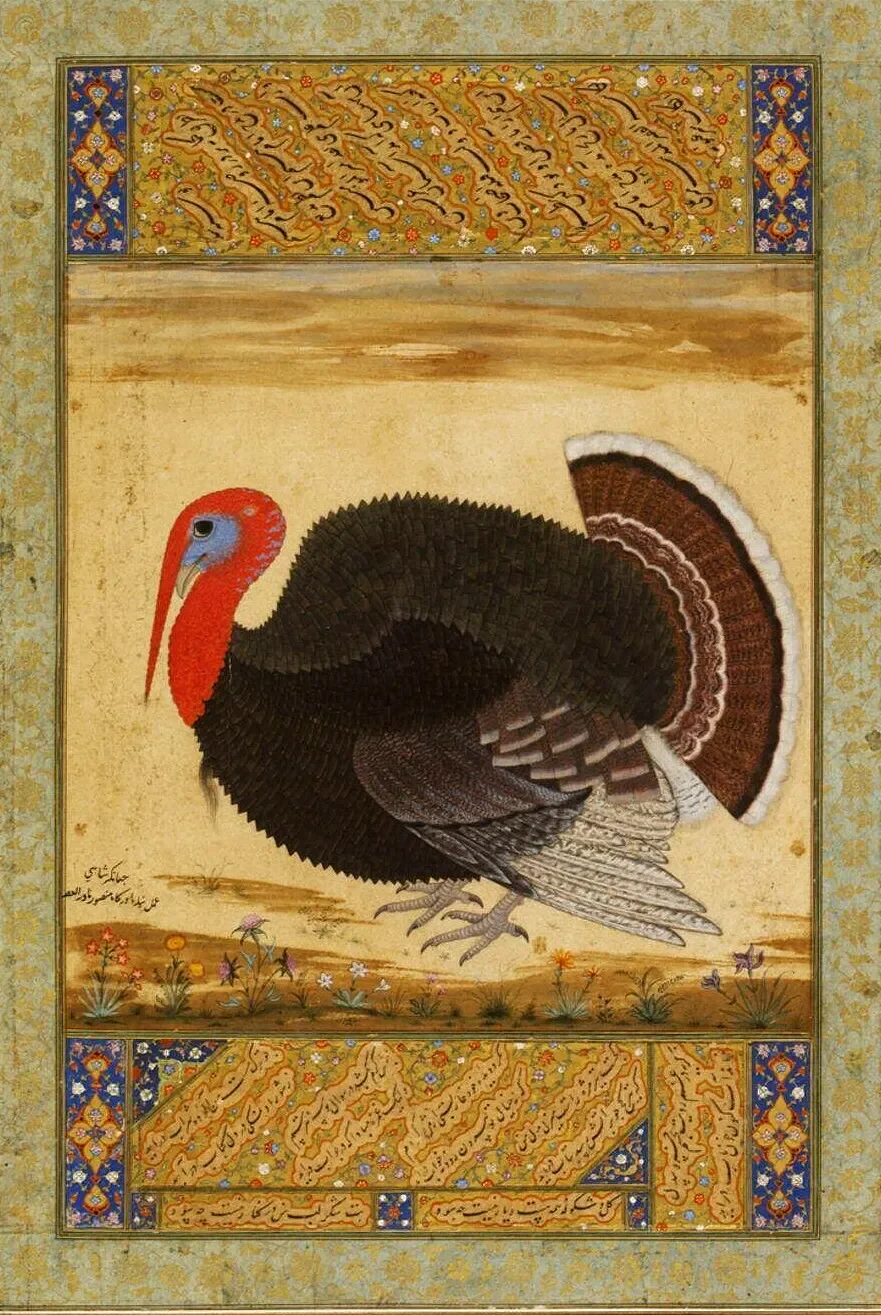
The arrival of the American turkey in Europe introduced another chapter to this naming history. Indigenous peoples of the Americas had domesticated the wild turkey long before European contact. Following the Spanish conquest of Mexico, the bird was transported across the Atlantic and gradually entered European markets during the sixteenth century. By the 1530s and 1540s, turkeys were appearing in England. English speakers, familiar with the African guinea-fowl already circulating under the name “turkey,” extended the designation to the newly introduced American species. Their resemblance in appearance helped establish the association. English naturalist William Turner examined the confusion surrounding these birds in his 1544 ornithological treatise, Avium Praecipuarum, drawing upon classical descriptions of the African meleagris and contemporary observations of unfamiliar fowl.⁴
The bird acquired different geographical identities as it travelled through European and Mediterranean languages. In Portuguese, it became known as peru, a name associated with the South American region. French speakers adopted dinde, derived from coq d’Inde, meaning “rooster of India,” reflecting the early European tendency to describe the newly encountered American continents as the Indies. In Arabic, the bird became known as dīk rūmī, or “Roman rooster,” while Turkish adopted hindi, meaning “Indian.” These names preserve the geographical assumptions and commercial associations through which Europeans, Ottomans and other societies encountered unfamiliar species.⁵
A Turkey at the Mughal Court: Jahangir and Ustad Mansur
By the early seventeenth century, the North American turkey had travelled across the Atlantic and entered the commercial networks of the Indian Ocean. Portuguese maritime activity connected the Americas with ports across South and Southeast Asia, bringing unfamiliar plants, animals and commodities into circulation. One such arrival reached the Mughal court of Emperor Jahangir (r. 1605–1627) in 1612.
Jahangir records the encounter in his memoirs, the Jahangirnama. He had instructed Muqarrab Khan, a trusted nobleman and imperial official, to visit Goa and acquire unusual objects and animals for the royal collection. Upon his return, Muqarrab Khan presented the emperor with several unfamiliar creatures obtained through Portuguese traders. Among them was an American turkey, a bird Jahangir had never encountered. The entire court was in awe of this strange new creature! Jahangir himself wrote:
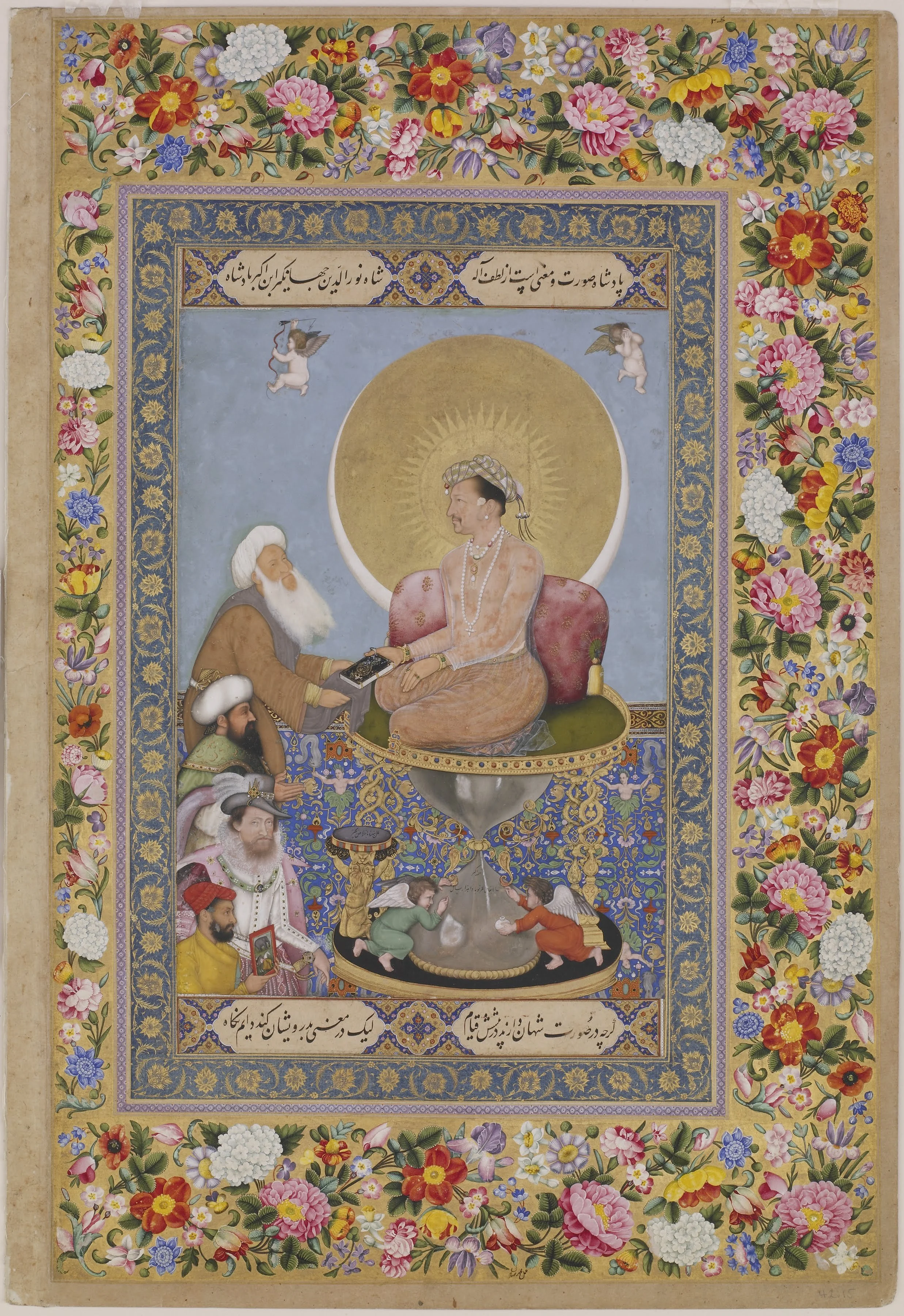
Bichitr, margins by Muhammad Sadiq, Jahangir Preferring a Sufi Shaikh to Kings from the “St. Petersburg Album,” 1615–18, opaque watercolor, gold and ink on paper, 46.9 × 30.7 cm (National Museum of Asian Art, Smithsonian, Washington, D.C.)
““I had ordered him [Muqarrab Khan, a high-ranking noble in the Mughal court] to go to the port of Goa on several items of business and see the viceroy, the governor of Goa, and to purchase any rarities he could get hold of there for the royal treasury… Without consideration for cost, he paid any price the Franks [Portuguese] asked for whatever rarities he could locate… He brought several very strange and unusual animals I had not seen before. No one even knew what their names were… One of the animals was larger in body than a peahen and significantly smaller than a peacock.”
The emperor devoted considerable attention to describing the bird’s appearance and behavior. This is among the aspects of Mughal history that I find most compelling: the opportunity to encounter the thoughts and observations of an emperor in his own words. Jahangir’s account offers something particularly valuable to the historian, for we are not merely reading about the reign of a powerful ruler but encountering the world as he himself observed and recorded it. The Mughals were distinctive in the care with which they cultivated their own historical narratives, leaving behind accounts through which their interests, intellectual curiosities, and observations of the natural world may still be examined. Returning to Jahangir’s description of the bird, he continues:
““Sometimes when it displays itself during mating, it spreads its tail and its other feathers like a peacock and dances. Its beak and legs are like a rooster’s. Its head, neck, and wattle constantly change color. When it is mating, they are as red as can be - you’d think it had all been set with coral. After a while, these same places become white and look like cotton. Sometimes they look turquoise. It keeps changing color like a chameleon. The piece of flesh it has on its head resembles a cock’s comb. The strange part about it is that when it is mating, the piece of flesh hangs down a span from its head like an elephant’s trunk, but then when it pulls it up, it stands erect a distance of two fingers like a rhinoceros’s horn. The area around its eyes is always turquoise-colored and never changes. Its feathers appear to be different colors, unlike a peacock’s feathers.””
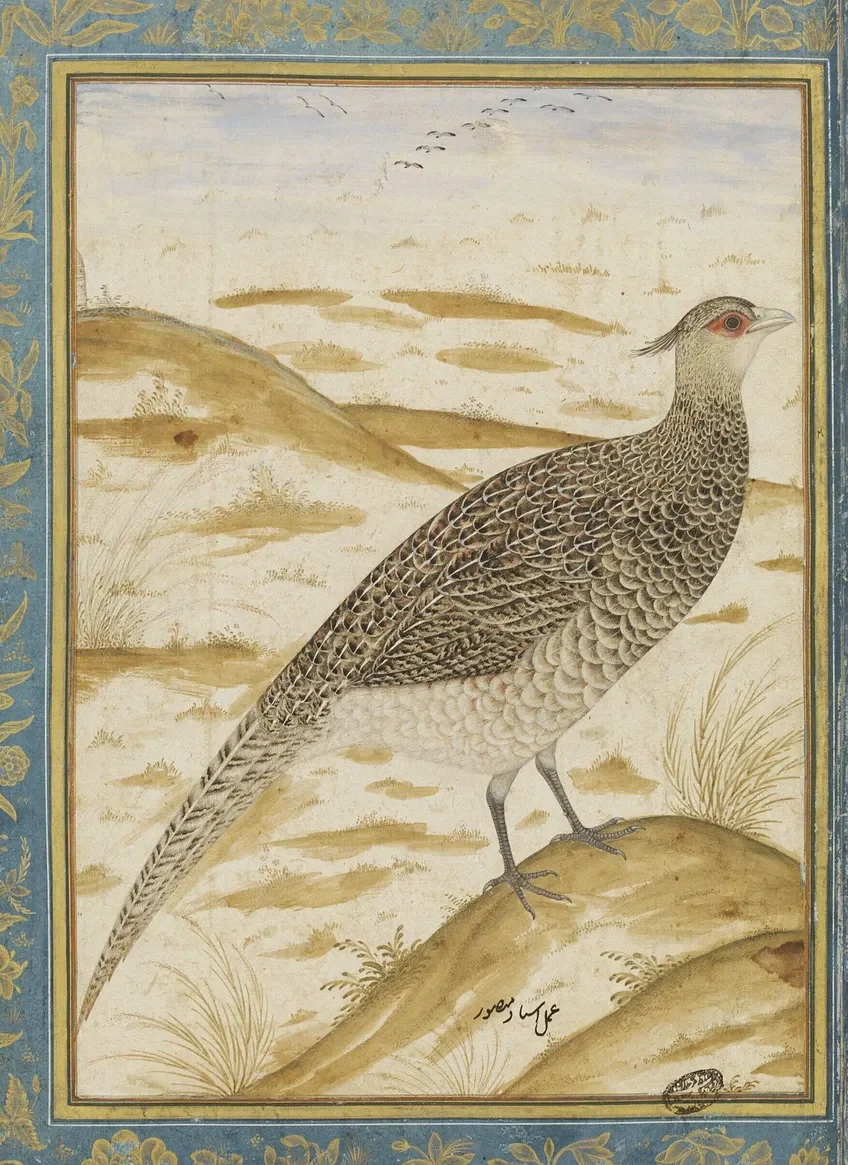
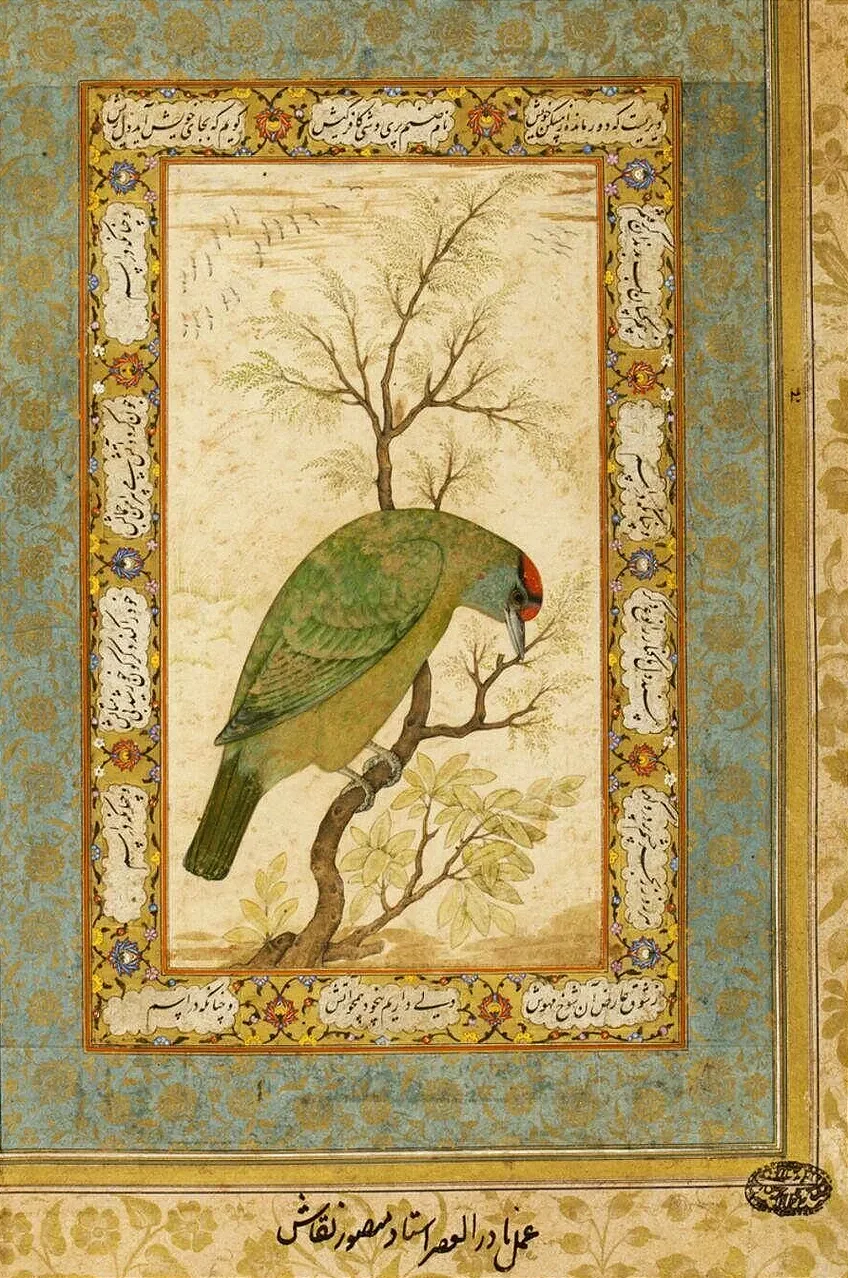
Jahangir also instructed his court painters to record these unusual animals in images, extending his written observations into the visual language of the imperial atelier. Among the artists working under his patronage was Ustad Mansur, one of the most accomplished painters of the Mughal court. Celebrated for his extraordinary ability to depict the natural world, Mansur received the honorific Nadir al-Asr, meaning “Wonder of the Age.”⁷ His studies of birds and animals demonstrate an exceptional command of fine detail, color and naturalistic representation.
Mansur’s Turkey Cock (Fig. 1), painted around 1612 in opaque watercolor on paper, is among the finest surviving examples of Mughal naturalistic painting. The bird is rendered with remarkable precision, its richly colored plumage, distinctive head and neck, and carefully delineated feathers revealing the artist’s close attention to its anatomy. The restrained background directs the viewer’s attention to the bird itself, whose imposing presence fills the composition. Mansur’s treatment reflects the close observation and technical accomplishment associated with the imperial atelier under Jahangir.
The painting also bears witness to the movement of species across early modern trade and diplomatic networks. Native to the Americas, the turkey had travelled across vast distances before reaching the Mughal court, where it attracted the emperor’s attention and entered the visual record through Mansur’s brush. Its appearance in Jahangir’s writings and in the imperial atelier’s paintings offers a rare account of the encounter between the natural history of the Americas and the artistic culture of Mughal India.
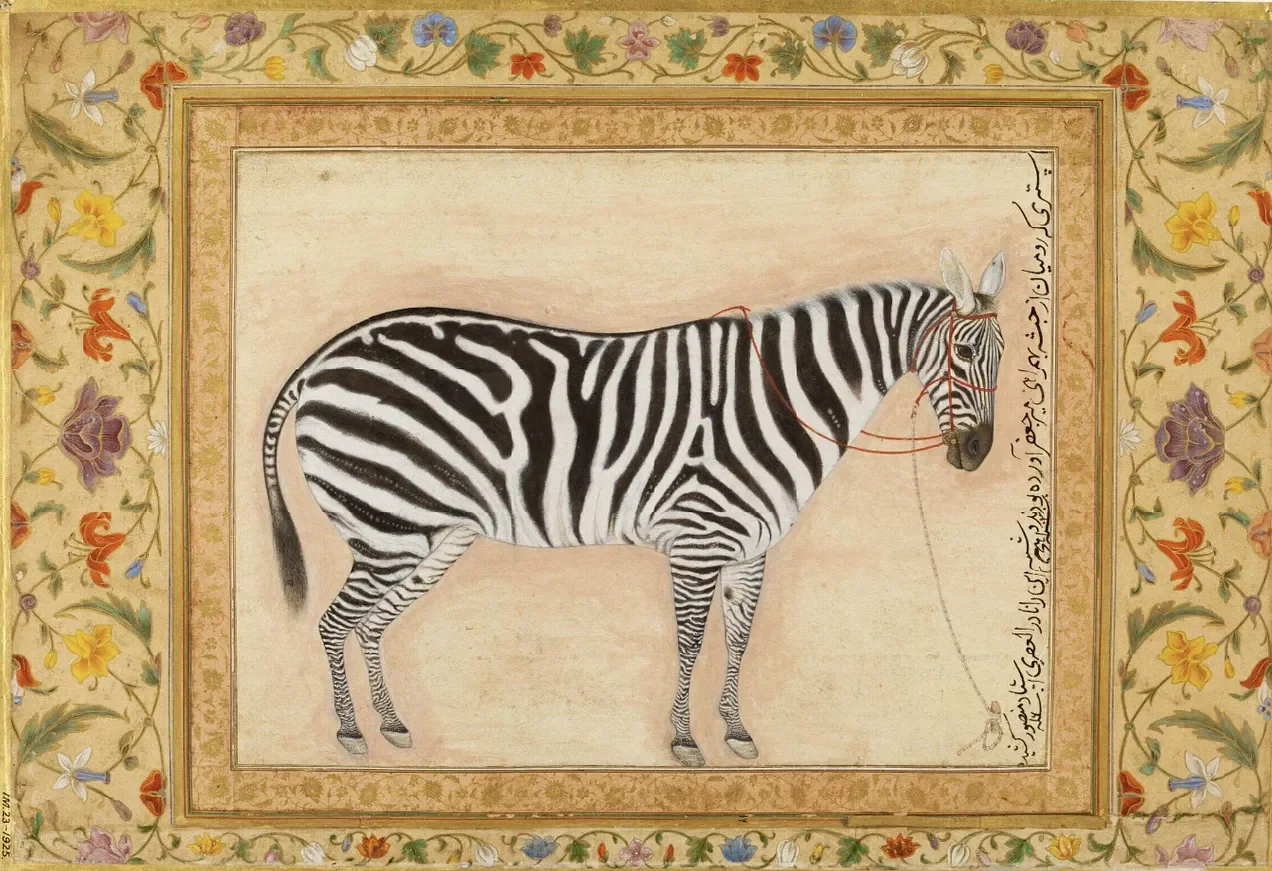
Mansur, Zebra (Burchell’s Zebra), 1621. Opaque watercolour and gold on paper. Mughal Empire. V&A Museum, London. Accession no. IM.23A-1925.
During Jahangir’s reign, numerous animals, including rare and exotic species brought from distant lands, were depicted by artists of the Mughal court, with Ustad Mansur producing some of the finest examples. An example is the beautiful zebra, pictured above.
A Bird with a Global History
The history of the turkey brings together several worlds often treated as distinct. Its English name retains the commercial associations of the Ottoman Mediterranean; its passage into Europe followed the Spanish conquest of the Americas; and its appearance in Jahangir’s memoirs and Mansur’s painting bears witness to the reach of Portuguese maritime commerce into Mughal India.
By the seventeenth century, the bird had travelled a considerable distance from its North American origins, finding a place in European vocabulary, imperial records and the naturalistic painting of the Mughal court. Its history offers a glimpse into the movements of living species and the encounters between distant societies in the early modern world.
Thanksgiving carries its own historical weight. Its observance in the United States is inseparable from the dispossession of Indigenous peoples and the suffering endured by Native communities, whose histories merit remembrance throughout the year. Such remembrance deserves a place in the week’s observances.
This essay was originally published on MENARAH’s Substack and is reproduced here for archival purposes, preserving the research for future reference. The original publication can be read here: [MENARAH Substack].
FOOTNOTES:
Elmer B. Harvey, Hans Elmar Kaiser, and Lauren Emery Rosenberg, An Atlas of the Domestic Turkey (Meleagris gallopavo): Myology and Osteology (U.S. Atomic Energy Commission, Division of Biology and Medicine, 1968).
Peter Mitchell, African Connections: Archaeological Perspectives on Africa and the Wider World (Bloomsbury Publishing, 2005).
L. McJannet, Early Modern England and Islamic Worlds (Palgrave Macmillan, 2011), 194.
Peter Goodfellow, Shakespeare’s Birds (Magna Books, 1994), 7–14.
Neil Forsyth, “The ‘Turkey’ and the ‘Guinea-Fowl’: A Chapter in the History of English Vocabulary,” English Studies 61, no. 6 (1980): 496–506.
Sugata Ray, “From New Spain to Mughal India: Rethinking Early Modern Animal Studies with a Turkey, ca. 1612,” in Picture Ecology: Art and Ecocriticism in Planetary Perspective, ed. Karl Kusserow (Princeton University Art Museum and Princeton University Press, 2021), 95.
Jahangir, The Jahangirnama: Memoirs of Jahangir, Emperor of India, trans. Wheeler M. Thackston (Freer Gallery of Art, Arthur M. Sackler Gallery, 1999), 395.
BIBLIOGRAPHY:
Forsyth, Neil. “The ‘Turkey’ and the ‘Guinea-Fowl’: A Chapter in the History of English Vocabulary.” English Studies 61, no. 6 (1980): 496–506.
Goodfellow, Peter. Shakespeare’s Birds. Magna Books, 1994.
Harvey, Elmer B., Hans Elmar Kaiser, and Lauren Emery Rosenberg. An Atlas of the Domestic Turkey (Meleagris gallopavo): Myology and Osteology. U.S. Atomic Energy Commission, Division of Biology and Medicine, 1968.
Jahangir. The Jahangirnama: Memoirs of Jahangir, Emperor of India. Translated by Wheeler M. Thackston. Freer Gallery of Art, Arthur M. Sackler Gallery, 1999.
McJannet, L. Early Modern England and Islamic Worlds. Palgrave Macmillan, 2011.
Mitchell, Peter. African Connections: Archaeological Perspectives on Africa and the Wider World. Bloomsbury Publishing, 2005.
Ray, Sugata. “From New Spain to Mughal India: Rethinking Early Modern Animal Studies with a Turkey, ca. 1612.” In Picture Ecology: Art and Ecocriticism in Planetary Perspective, edited by Karl Kusserow, 94–113. Princeton University Art Museum and Princeton University Press, 2021.