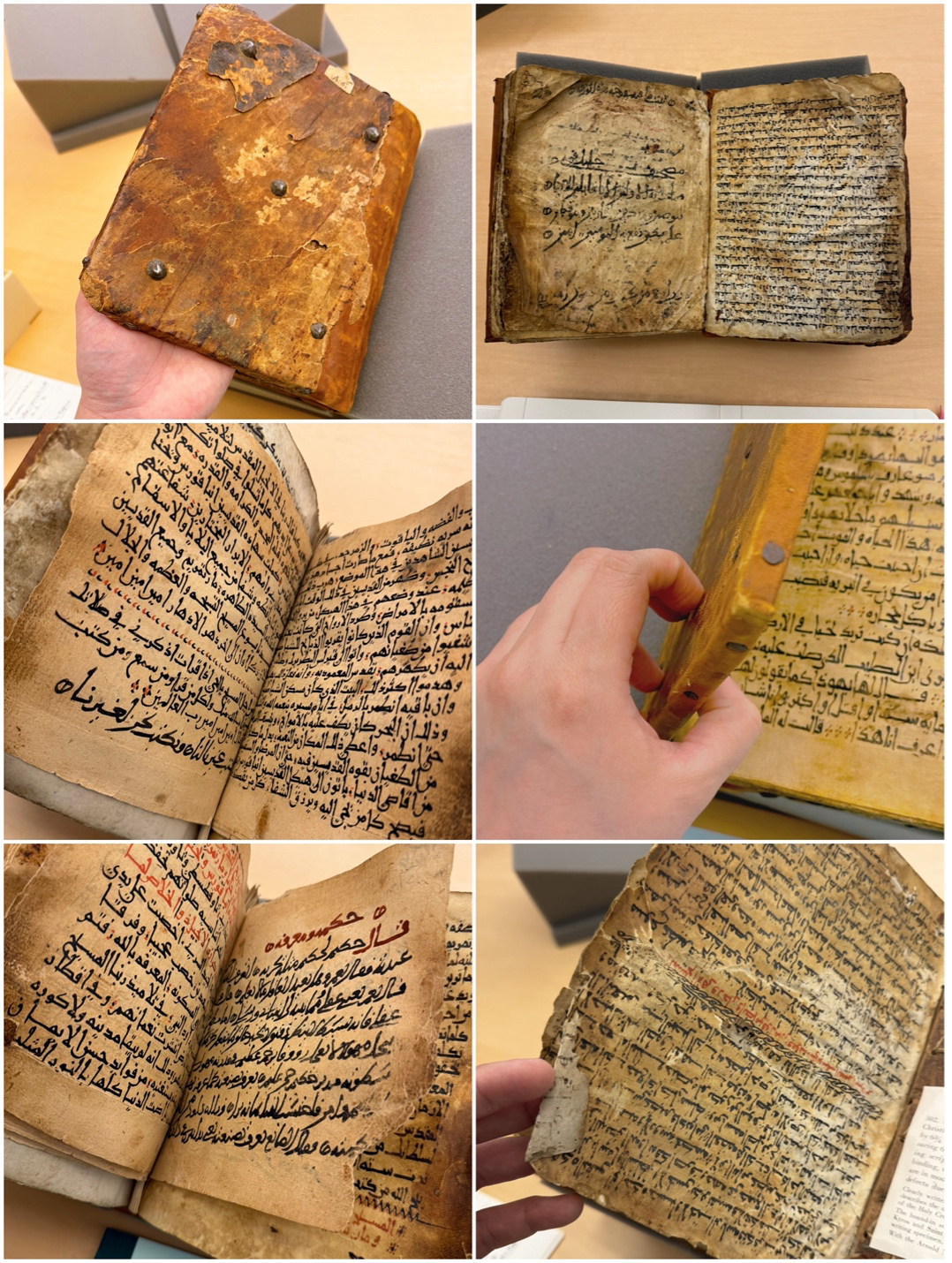
Manuscript: BV 69, Muṣḥaf jalīl fīhi .... / مصحف جليل فيه
Date: Probably mid-10th century, circa 950 CE
Language: Arabic
Place of Origin: Sinai, Egypt (Saint Catherine’s Monastery, Mount Sinai)
Material: Parchment
Extent: 52 leaves; 212 x 170 mm (some leaves 170 x 120 mm), bound to 215 x 175 mm
Script: New Style Arabic script in black ink, pointed
Binding: Brown leather over wood, secured with nails
Description:
This manuscript is an incomplete codex containing a collection of homilies and saints' and martyrs’ lives, originally part of a larger now-dispersed manuscript produced at Saint Catherine’s Monastery on Mount Sinai. The table of contents lists twenty-two works, yet only portions of the first and fourth remain in this fragmentary volume. Additional paper leaves, added in a later hand, preserve the incomplete account of the martyrdoms of Anbā Qūris, Yuḥannā, and the three virgins and their mother, underscoring the manuscript’s continued use and augmentation after its initial creation.
Physical Features:
The text is arranged in long lines of fifteen to seventeen per page, penned with rubrications in red that provide visual emphasis and organization. The manuscript is foliated in modern pencil in the lower gutter margin of the recto pages. Its binding of brown leather over wooden boards is original, featuring nails for reinforcement, reflecting its durable and functional design for long-term use.
Provenance:
This codex has a rich ownership history, having passed through several notable hands including Arnold J. Mettler and Howard Lehman Goodhart, who donated it to Bryn Mawr College in 1949. It previously circulated through European auction houses and was part of collections such as the Arnold Mettler-Specker Collection and the Zurich Zentralbibliothek loan, signifying its recognized importance among collectors and scholars of Arabic Christian manuscripts.
Scholarly Notes:
The manuscript’s association with Saint Catherine’s Monastery and its mid-10th-century dating situate it within an important period of Christian Arabic manuscript production. Its contents, focusing on hagiographical and martyrological texts, offer valuable insights into the devotional practices and literary traditions of Eastern Christianity in the medieval period. The manuscript’s layered history of additions and ownership illustrates the continued reverence and scholarly interest in these texts over centuries, making it a critical witness to the transmission and preservation of early Christian literature in Arabic.