A Timurid-Era Copy of Niẓāmī’s Khamsah: Manuscript BV 51 from Shiraz (ca. 1405–1414)
نسخهای تیموری از خمسهٔ نظامی: دستنوشتهٔ BV 51 از شیراز (حدود ۸۰۷–۸۱۶ هـ.ق)
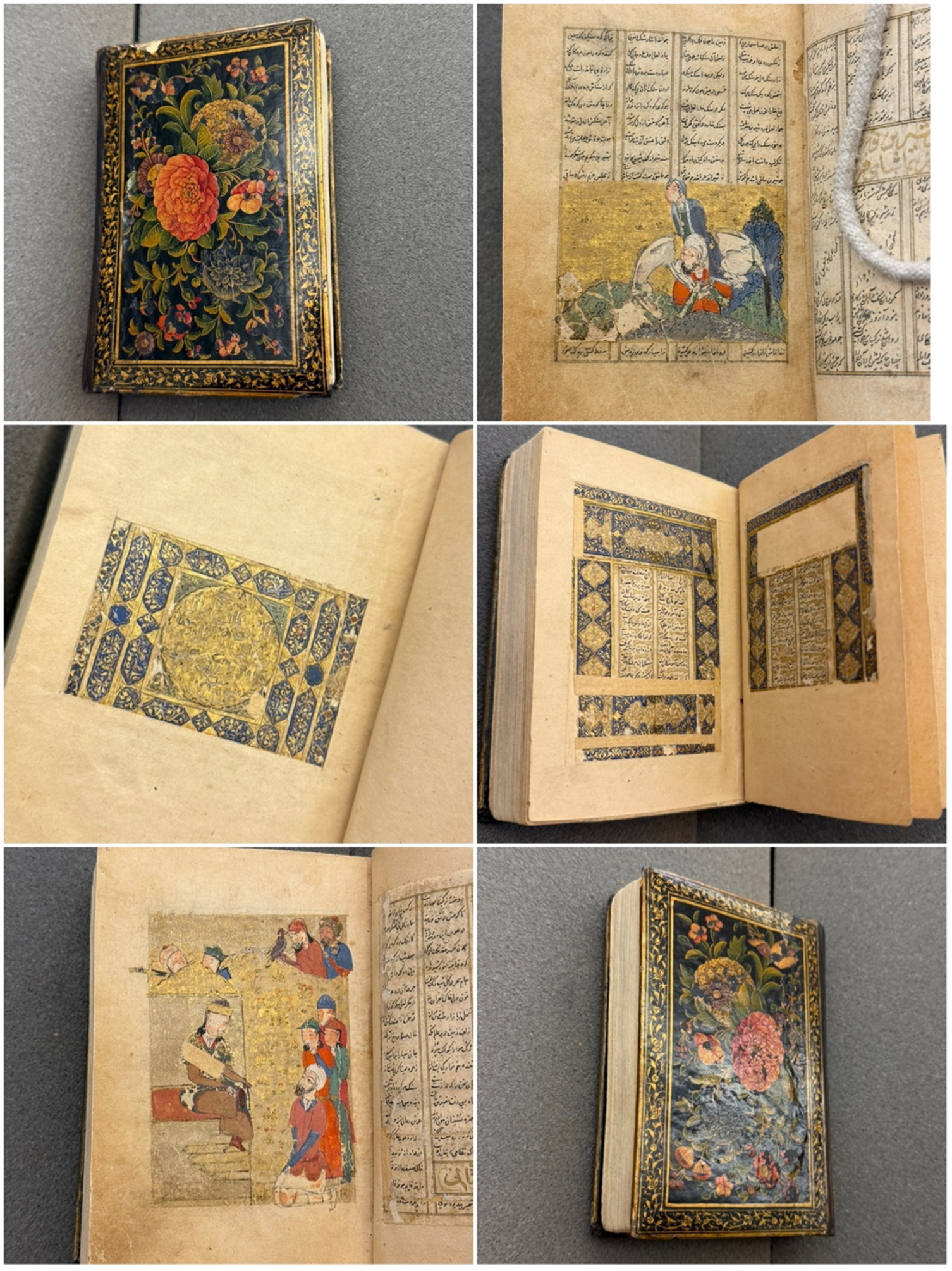
Manuscript: BV 51, Khamsah / [خمسه]
Author: Niẓāmī Ganjavī (1140/41–1202/3)
Date: ca. 1405–1414
Language: Persian
Place of Origin: Shiraz, Iran
Material: Paper
Extent: 183 foliated leaves; leaf size 108 × 67 mm (written area approximately 73 × 50 mm); bound dimensions 110 × 75 mm
Script: Nastaʿlīq in black ink, pointed
Binding: Lacquered covers with floral designs on a black ground, framed by a floral border; interior boards with brown field, black frame, and three gold-tooled inset frames; housed in a slipcase labeled “Collected poems in Persian” in gold
Binding: Lacquered covers with floral designs on a black ground, framed by a floral border; interior boards with brown field, black frame, and three gold-tooled inset frames; housed in a slipcase labeled “Collected poems in Persian” in gold
Description:
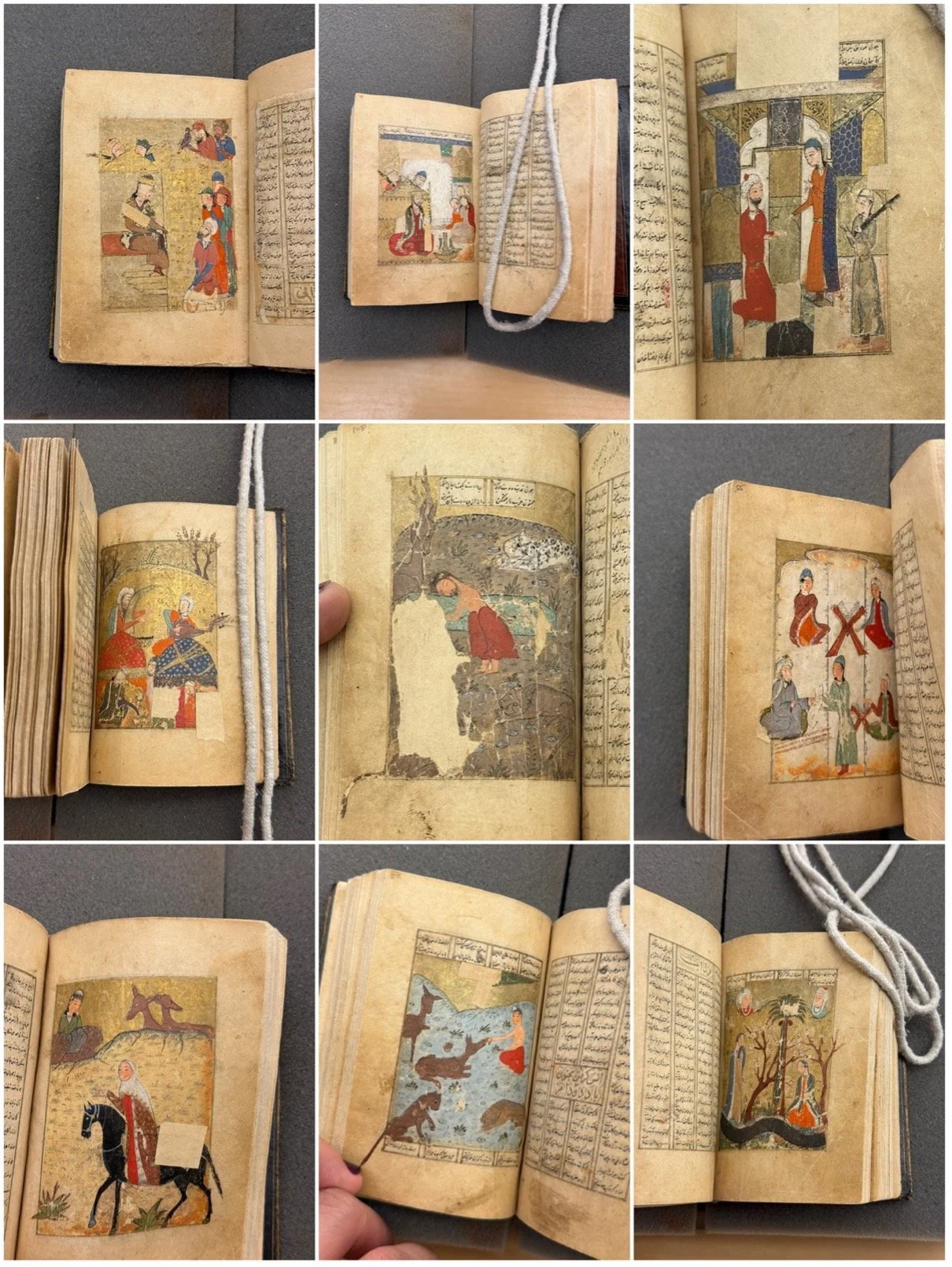
This early 15th-century manuscript contains an incomplete copy of Niẓāmī’s Khamsah. Present are small sections of Makhzan al-asrār, most of Laylī va Majnūn, approximately half of Khusraw va Shīrīn, and the first third of Haft Paykar; the Iskandarnāmah is absent. The manuscript includes 24 miniature paintings—some unfinished—and features elaborate illuminated pages. It was copied by Ḥasan al-Ḥāfiẓ, likely in the workshop of either Iskandar Sulṭān or Ibrāhīm Sulṭān.
Physical Features:
The text is arranged in four columns of 19 lines per page, with gold ruling between and around columns. Titles are written in gold. An illuminated medallion in gold and blue appears on the opening page (f. 3r), followed by a dual-page frontispiece (f. 3v–4r) with cloudband text panels. A further illuminated headpiece in gold and blue is found at f. 111v. The 24 miniatures (f. 5r, 8r, 12r, 14r, 15r, 18v, 27v, 33r, 38v, 55r, 57v, 60v, 68v, 73v, 82r, 92v, 101r, 107r, 108r, 121v, 131r, 134r, 134v, 142r, 158v) depict key narrative episodes. Catchwords appear on every verso, and modern foliation in pencil marks each recto’s upper left corner.
Scholarly Notes:
This manuscript exemplifies the refined literary and artistic production of early 15th-century Shiraz. The combination of exquisite lacquer binding, gold illumination, and miniature painting reflects the prestige of royal workshops under the Timurid princes. Its partial state, with the Iskandarnāmah missing, raises questions about its production history and later handling, while the unfinished miniatures offer valuable insight into Timurid painting techniques in process.