A Leaf-Shaped Qurʾan on Green-Dyed Paper with Gold and Silver Illumination (Nineteenth Century), Special Collections, University of Sydney
Qur’an 16:6 (Sūrat al-Naḥl)
«و برای شما در آنها زیبایی است، آنگاه که آنها را شامگاهان بازمیآورید و آنگاه که بامدادان به چرا میبرید.»
“And for you in them is beauty when you bring them in for the evening and when you send them out to pasture.”
I had the opportunity to study this Qur’an in the Special Collections of the University of Sydney Library, where it remains accessible to researchers by request, although it has not yet been incorporated into the Library’s online database.
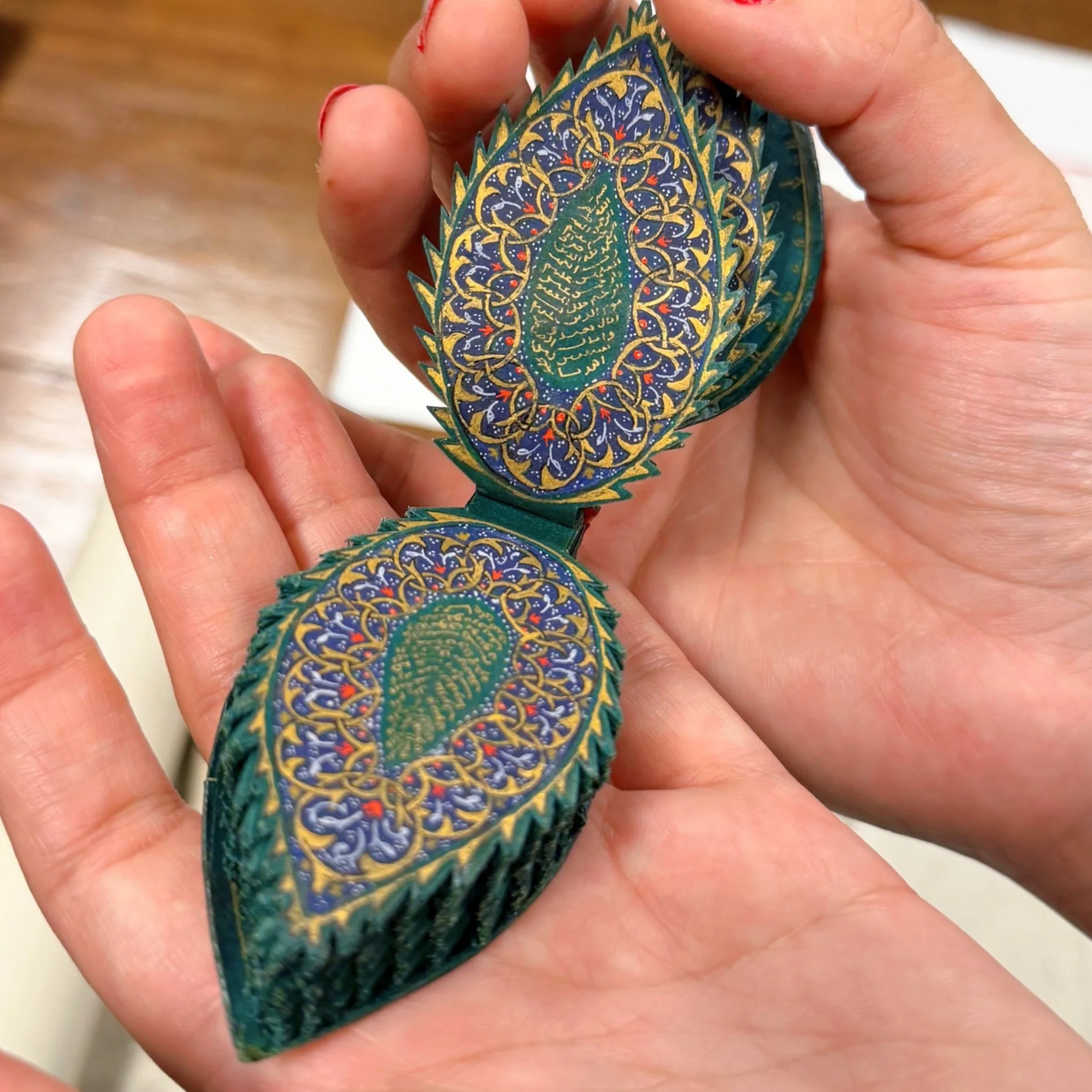
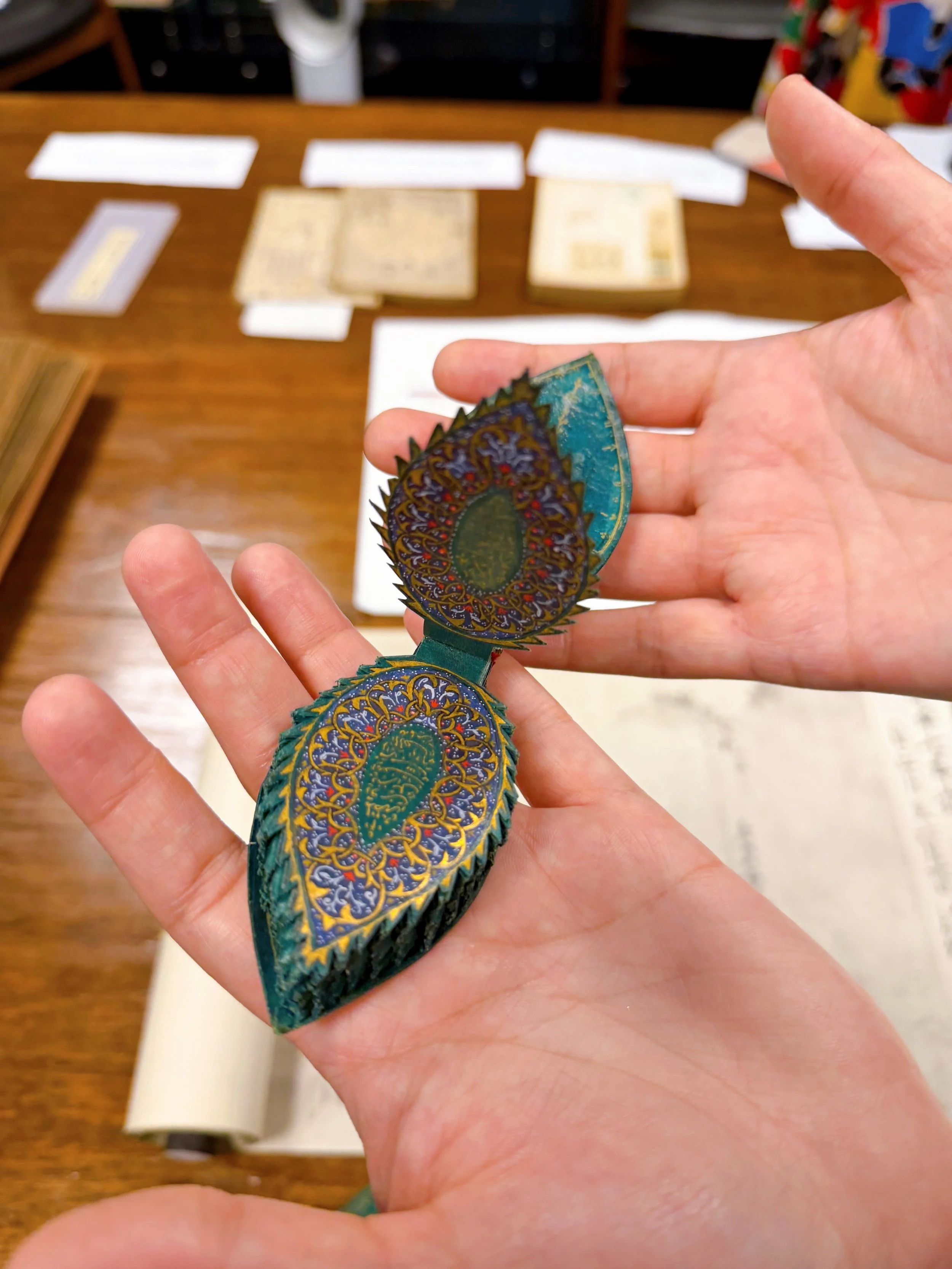
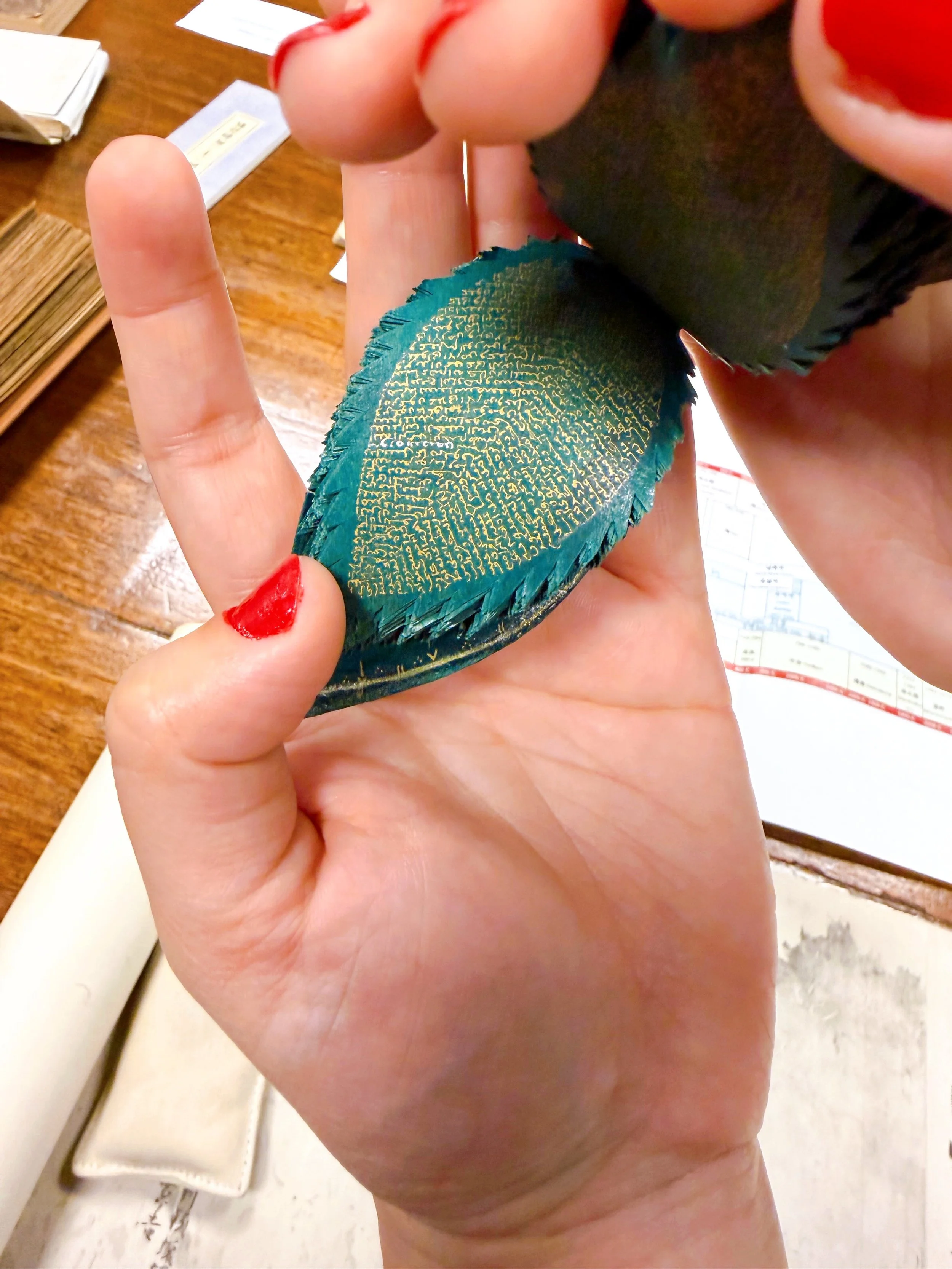
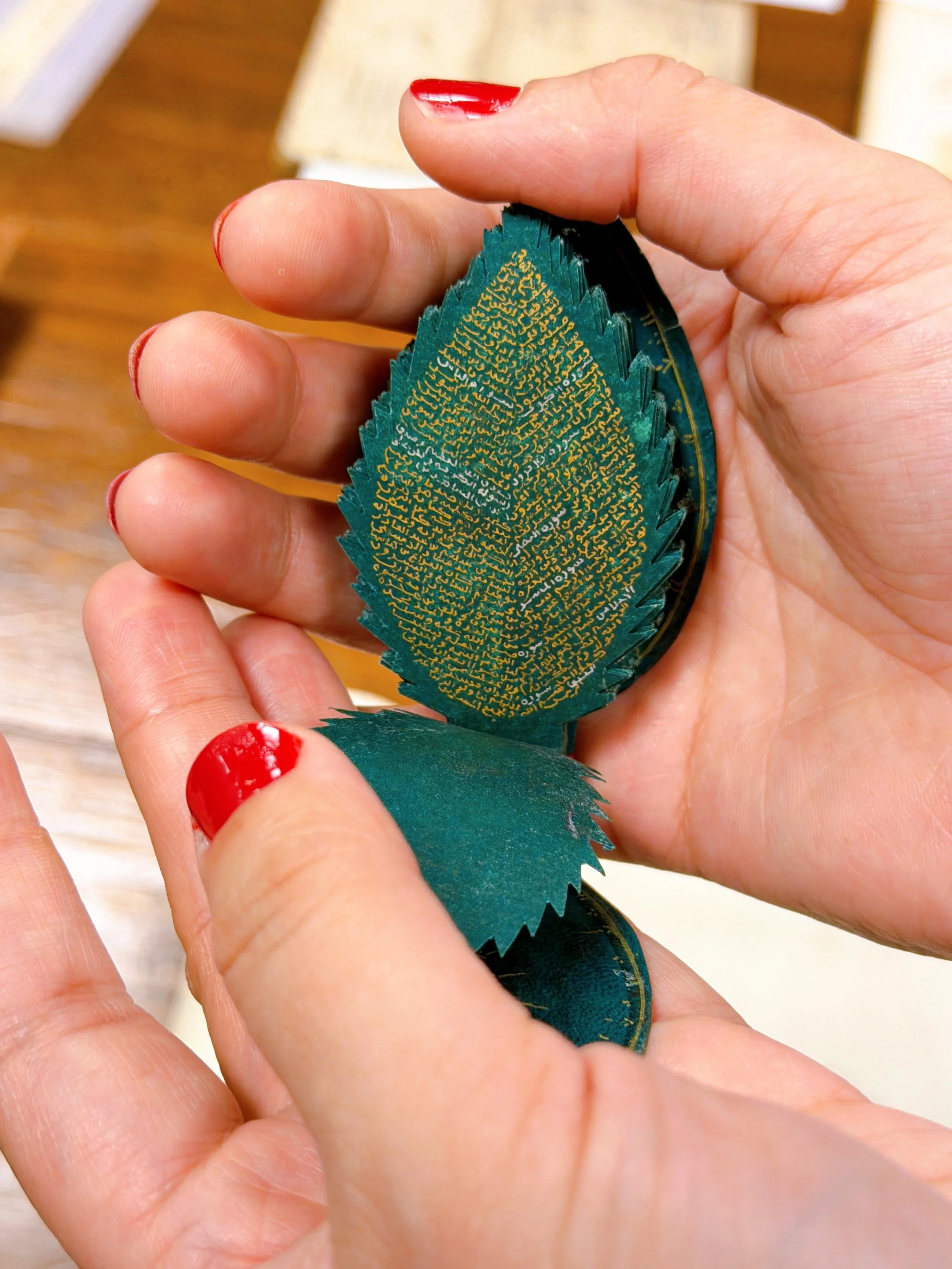
This miniature Qurʾan, preserved in the Special Collections of the University of Sydney, may be assigned on stylistic grounds to the early nineteenth century. Executed upon paper dyed a deep green and written throughout in gold and silver ink, it assumes the shape of a leaf with finely serrated margins. Such a design appears to evoke the Ṭūbā tree, which occupies a distinguished place within Islamic conceptions of Paradise. The disposition of the text in two tapering columns accommodates the unusual format with considerable ingenuity, whilst the luminous metallic inks employed by the scribe contribute to the manuscript's devotional and aesthetic character. Objects of this kind furnish valuable evidence for the diversity of Qurʾanic book production beyond the more familiar codex form.
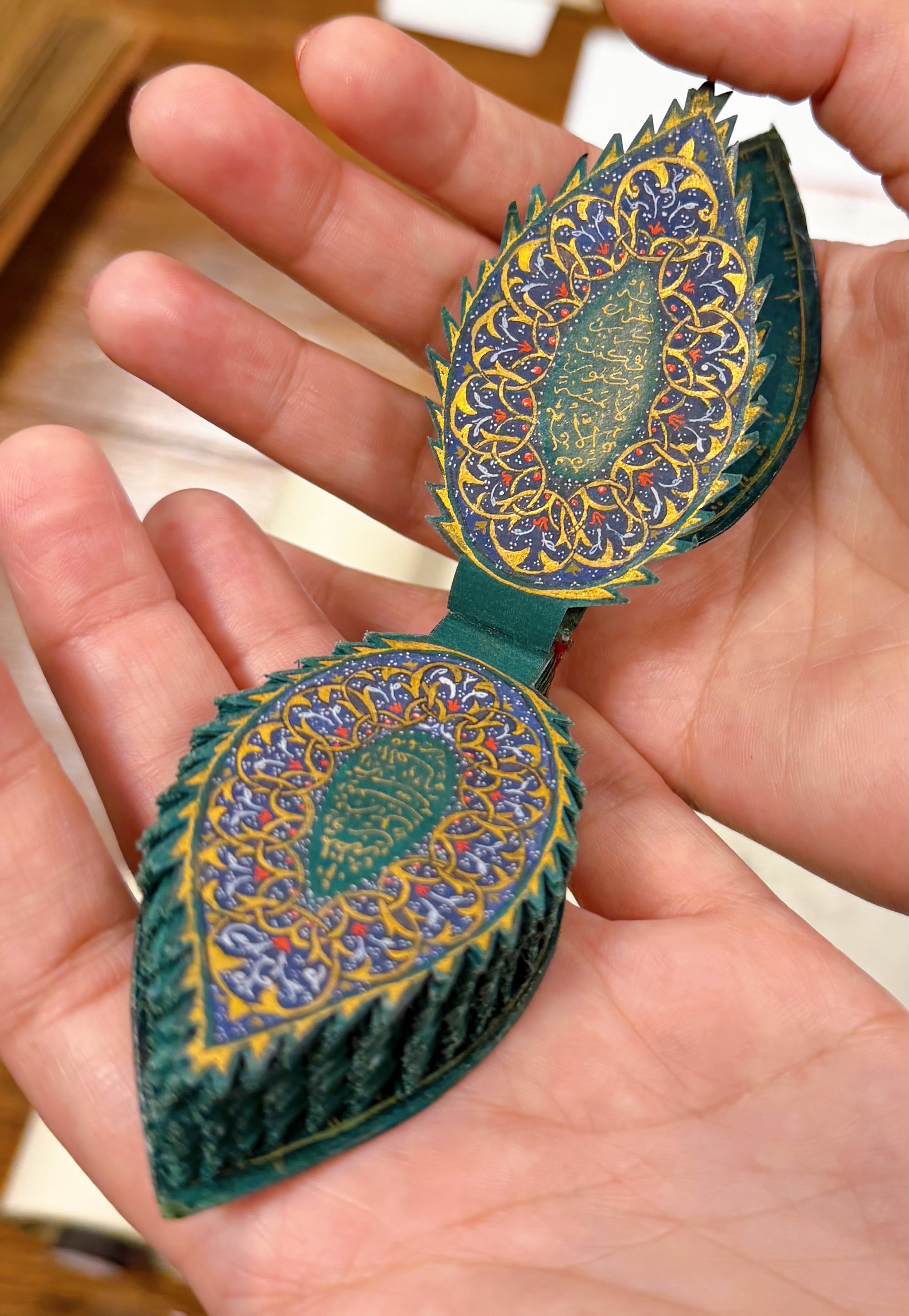
This manuscript occupies a noteworthy place within the history of Qurʾanic book production in South Asia during the nineteenth century. Its execution demonstrates the continued vitality of artistic and calligraphic traditions that had flourished under centuries of Islamicate patronage. Although produced after the political decline of the Mughal Empire, it preserves many of the aesthetic principles associated with earlier centres of manuscript production, where the arts of calligraphy, illumination, and bookbinding were cultivated with particular distinction. The manuscript preserved today in the Special Collections of University of Sydney thus provides a valuable witness to the enduring prestige of these traditions in the decades following the formal dissolution of Mughal authority in 1857.
The text is written in a refined naskh hand employing gold and silver inks upon a ground of dark green paper. The script belongs to the tradition that achieved particular prominence from the thirteenth century onwards through the reforms associated with the celebrated calligrapher Yaqut al-Musta'simi (d. 1298). By the Mughal period (1526–1857), naskh had become the preferred script for the transcription of Qurʾanic texts across much of South Asia, flourishing in centres such as Delhi, Lucknow, Lahore, and Hyderabad. The letters are carefully proportioned, the spacing between words is regular, and the text remains remarkably legible despite the small scale of the manuscript. Such workmanship reflects a long-established scribal tradition in which clarity of transmission was inseparable from aesthetic accomplishment.
The use of metallic inks contributes significantly to the manuscript's visual character. Gold occupied a prominent place in Qurʾanic illumination from an early date, appearing in manuscripts produced from North Africa to Central Asia. Silver, though less durable owing to its tendency to oxidise over time, was likewise employed in luxury copies intended for patrons of considerable means. In the present manuscript, silver is used to distinguish the sūrah headings, while the vowel signs are likewise rendered in silver rather than in contrasting colours. This practice recalls earlier manuscript traditions in which a restrained palette was preferred. The widespread use of red, blue, and other coloured inks for vocalisation became increasingly common in later centuries and was eventually standardised in many printed editions of the Qurʾan.
The illuminated opening pages display an accomplished decorative programme composed of scrolling arabesques, floral ornament, and geometric elements executed in gold, red, white, and deep blue pigments. Such motifs belong to a visual vocabulary that had circulated throughout the Persianate and Indo-Islamic world for centuries. Similar ornamental schemes may be observed in Qurʾans produced under the Timurid courts of Herat during the fifteenth century, the Safavid workshops of Isfahan during the sixteenth and seventeenth centuries, and the Mughal ateliers of Agra and Delhi. Across these centres, illumination was regarded as an appropriate accompaniment to the sacred text, reflecting the Qurʾanic conception of divine revelation as نُور (nūr), or divine light. Within Qurʾanic manuscripts, illumination served practical as well as aesthetic purposes, marking significant textual divisions and guiding the reader through the sacred text. The elaborate frontispieces that precede the opening chapter of the Qurʾan acquired particular importance as expressions of reverence for the revealed word.
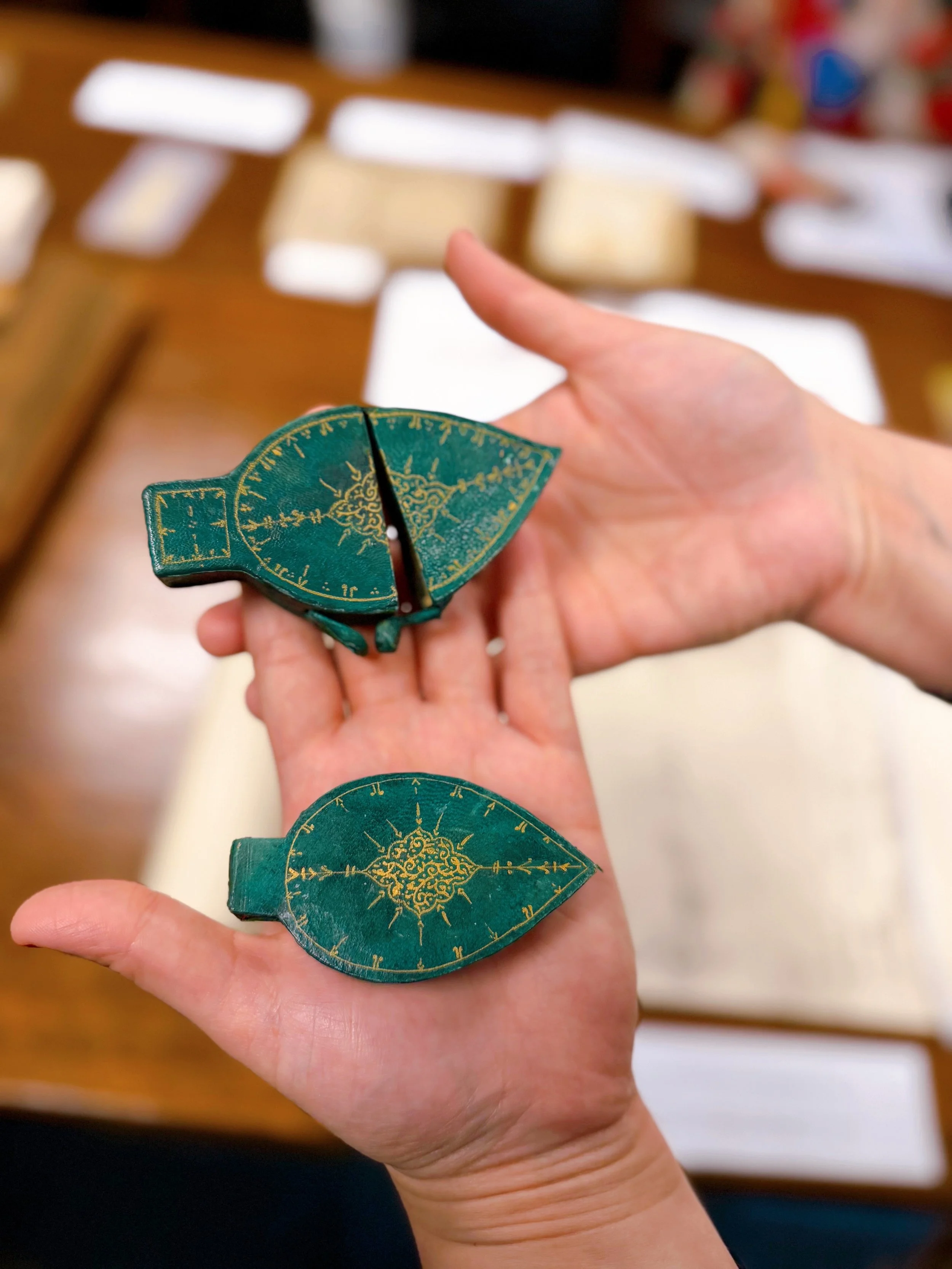
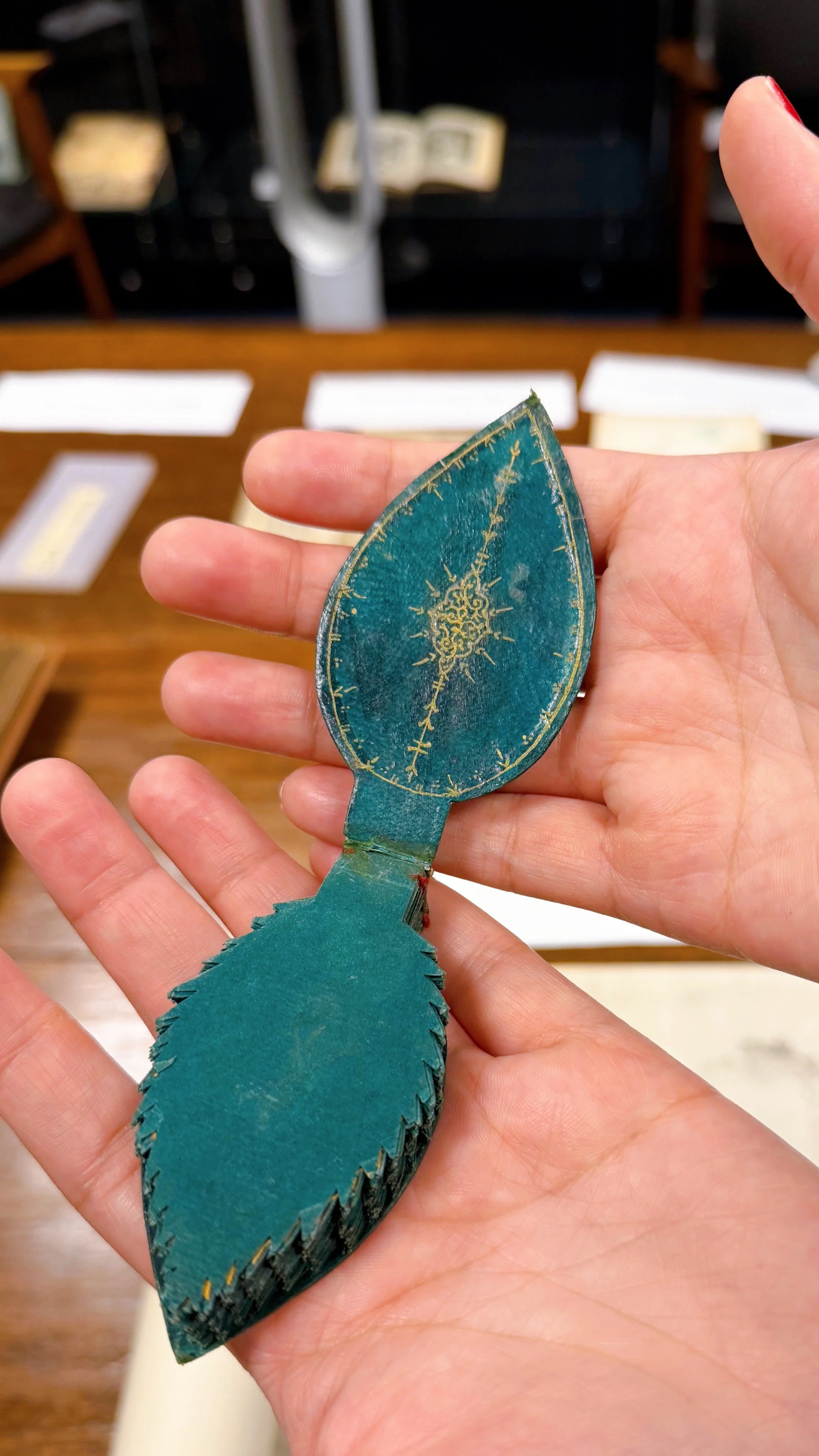
The most unusual feature of the manuscript lies in the shaping of its folios. Each leaf has been cut to resemble the form of a natural leaf, with a pointed apex and finely serrated edges. Such departures from the conventional rectangular codex are uncommon, though they are by no means without precedent. The history of Islamic bookmaking includes examples of circular manuscripts, octagonal manuscripts, miniature Qurʾans, and talismanic scrolls produced for devotional, ceremonial, or personal use. The present example belongs to this broader tradition of experimentation within the arts of the book, demonstrating the willingness of patrons and craftsmen to explore novel forms while preserving the integrity of the sacred text.
The leaf-shaped format may plausibly be associated with the Ṭūbā tree, which occupies a distinguished place in Islamic descriptions of Paradise. Although the tree is not named explicitly in the Qurʾan, it appears frequently in prophetic traditions and later devotional literature. Medieval authors describe it as a magnificent tree whose branches extend throughout Paradise, offering shade and abundance to the blessed. Its association with the verse طُوبَىٰ لَهُمْ وَحُسْنُ مَآبٍ (“Blessedness is theirs, and a fair place of return”; Qurʾan 13:29) contributed to its enduring place within the Islamic imagination. Whether the manuscript was explicitly intended to evoke the Ṭūbā tree cannot be established with certainty; nevertheless, the association would have been readily intelligible to a Muslim audience familiar with devotional literature and popular accounts of the heavenly garden.
The choice of green paper further reinforces these associations. Green occupies a prominent position within Islamic visual culture and appears frequently in religious architecture, textiles, manuscripts, and ceremonial objects. Medieval and early modern authors regularly connected the colour with Paradise, while Qurʾanic descriptions portray the inhabitants of heaven clothed in garments of green silk: عَالِيَهُمْ ثِيَابُ سُندُسٍ خُضْرٌ وَإِسْتَبْرَقٌ (Qurʾan 76:21). The application of gold and silver script upon this richly coloured ground creates an effect of considerable splendour and accords with a broader preference for precious materials in the production of luxury Qurʾans.
Manuscripts of diminutive size formed an important category within the devotional life of the Islamicate world. Portable Qurʾans were copied for travellers, rulers, soldiers, and private individuals. Some were carried in protective cases, suspended from the person, or preserved within domestic settings as treasured devotional possessions. Particularly celebrated examples survive from Mughal India during the seventeenth and eighteenth centuries, from Qajar Iran (1789–1925), and from the Ottoman domains, where miniature Qurʾans were often housed in precious metal cases and carried by rulers, military officers, and pilgrims. Comparable examples are preserved today in the collections of the Topkapi Palace Museum, the Chester Beatty Library, and the British Library. The present manuscript belongs to this wider tradition of small-format Qurʾans intended to inspire devotion through the intimacy of their scale and the refinement of their execution.
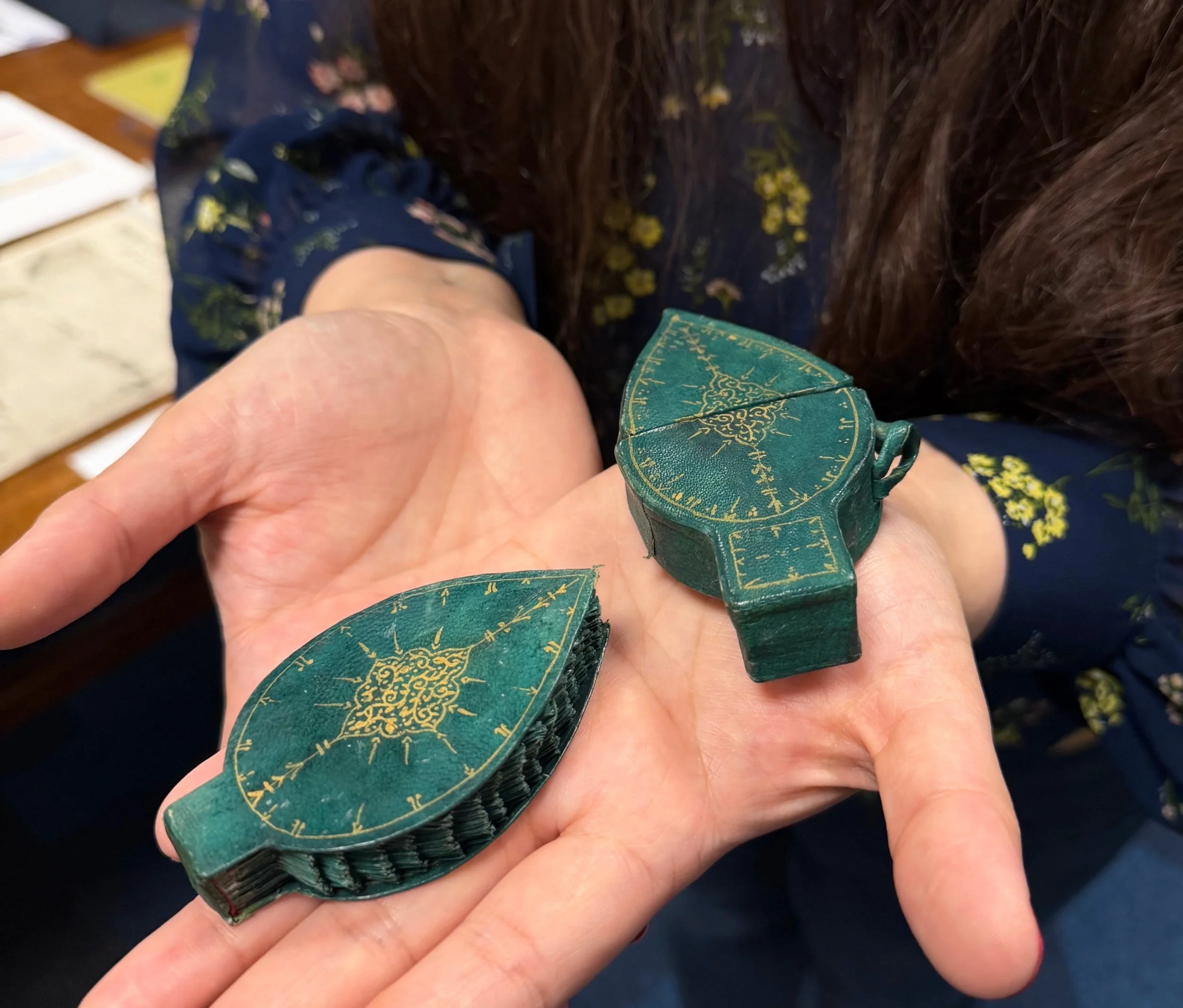
The manuscript is accompanied by a carefully constructed case fashioned to accommodate its distinctive contours. Such protective enclosures formed an integral component of many luxury manuscripts, safeguarding the text while simultaneously enhancing its presentation. The close correspondence between manuscript and container suggests that both were conceived as parts of a unified ensemble. Considered together, the calligraphy, illumination, unusual format, and custom housing reveal the degree to which the arts of the book could be integrated into a coherent devotional object.
Surviving examples that combine a leaf-shaped format, green-dyed paper, and extensive use of gold and silver inks remain uncommon within published collections. The manuscript preserved in the Special Collections of the University of Sydney therefore offers valuable evidence for the diversity of nineteenth-century Qurʾanic production in South Asia. It illustrates the persistence of artistic traditions inherited from earlier centuries while providing insight into the inventive possibilities available to later craftsmen. Standing within a lineage that extends from the earliest Qurʾanic codices of the seventh and eighth centuries to the great manuscript workshops of Baghdad, Herat, Tabriz, Isfahan, Agra, and Delhi, it occupies a distinctive position within the history of Islamic bookmaking. As an artefact of devotion, a work of calligraphy, and an example of highly accomplished craftsmanship, it remains a compelling testament to the enduring richness of the Indo-Islamic manuscript tradition.
_______________
My sincere thanks to the wonderful staff of https://www.library.sydney.edu.au/browse/special-collections who so generously facilitated my visit. Their Rare Books collection is extensive and includes many remarkable and special items, particularly from the Middle Eastern world.
I would especially like to extend my heartfelt thanks to Julie, Vanessa, Kim, Marthe, and Pippa, whose generosity and dedication made my research experience both productive and deeply enjoyable.